A Naval Milestone: China Commissions Third Aircraft Carrier, Fujian
The Live info Media
China Enters the ‘Three-Carrier Era’
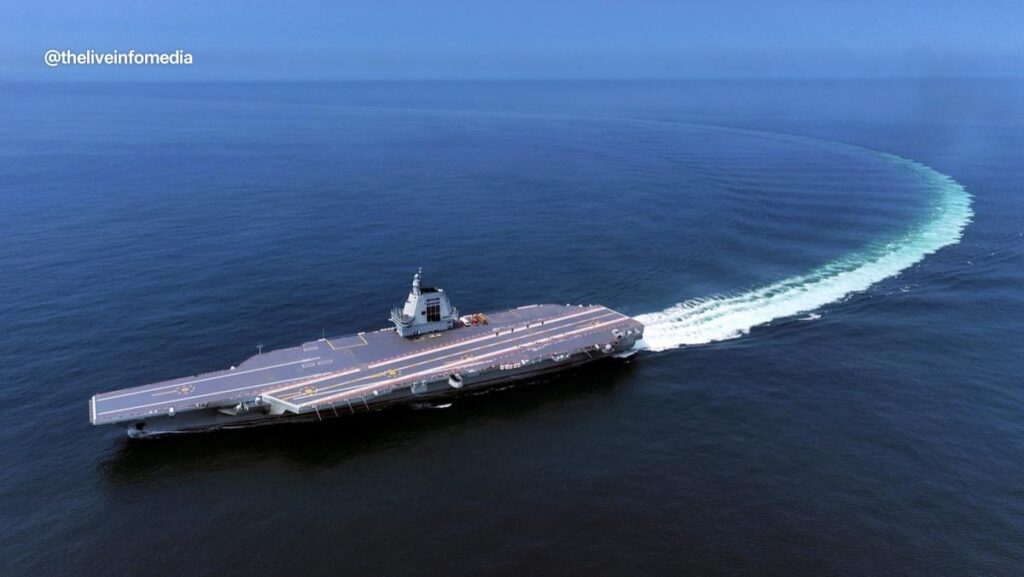
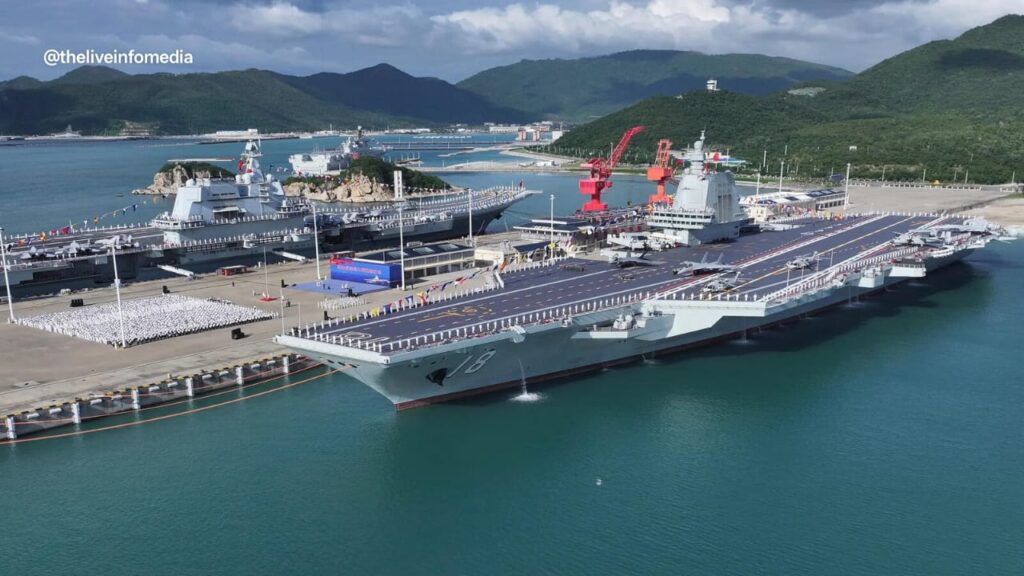
China has achieved a major milestone in its naval modernization efforts by officially commissioning its third aircraft carrier, the Fujian. This step solidifies China’s position as operating the second largest number of aircraft carriers in the world, pushing it ahead of countries like India and the UK, which each operate two. The commissioning ceremony, attended by top leader Xi Jinping, was announced on Friday, November 7, 2025, and signals China’s growing ambition to project military power far beyond its coastal waters.
Fujian Represents a Technological Leap Forward
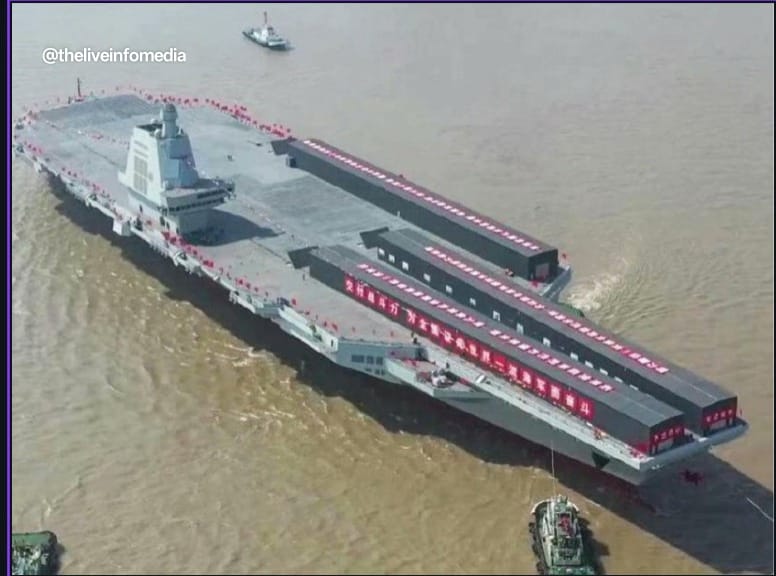
The Fujian (Hull 18) is a landmark achievement because it is China’s first fully domestically designed and built aircraft carrier. Unlike its two predecessors, the Liaoning (refurbished from a Soviet ship) and the Shandong (based on the Soviet design), the Fujian is a massive 80,000-ton warship that features a revolutionary new technology: an electromagnetic catapult launch system (EMALS). This feature is a significant jump in naval technology, as the EMALS is currently only used on the US Navy’s newest carrier, the USS Gerald R. Ford.
Electromagnetic Catapult: A Game-Changer
The electromagnetic catapult system replaces the upward-sloping “ski-jump” deck used on the Liaoning and Shandong. This advanced technology offers several key advantages. It allows the Fujian to launch heavier, fully-loaded warplanes with full fuel and weapons, significantly boosting their range and firepower. More importantly, it can launch crucial support aircraft like the KJ-600 early-warning and control plane and China’s latest J-35 stealth fighter, giving the carrier the capability to operate effectively against distant targets while far out at sea.
A Rival to America’s Carriers
The Fujian‘s technology puts it closer in capability to the US Navy’s supercarriers. While the US still leads with 11 carriers, and its Ford-class is larger (over 100,000 tons) and nuclear-powered, the Fujian‘s EMALS technology rivals the best in the world. The EMALS is more efficient, puts less stress on aircraft, and requires less maintenance compared to the older steam catapults used on the US Navy’s ten Nimitz-class carriers. The Fujian has three catapults, compared to the Ford‘s four.
A Key Limitation: Conventional Power
A primary difference between the Fujian and its American counterparts is its propulsion system. Like its two predecessors, the Fujian is conventionally powered (non-nuclear). This is a crucial limitation, as it gives the carrier an estimated operational range of 8,000 to 10,000 nautical miles, meaning it must frequently refuel. In contrast, America’s nuclear-powered carriers have virtually unlimited range, only being limited by crew and supply needs. Reports suggest China is working on nuclear propulsion for its next-generation carriers.
Projection of Power in Disputed Waters
The commissioning of the Fujian will significantly enhance China’s ability to project naval power in the Pacific. It is expected to play a major role in asserting China’s claims in highly disputed territories, including the East China Sea, the South China Sea, and the Taiwan Strait. Military analysts believe that having three carriers will allow China to ensure at least one carrier is ready for operations at all times, even while others are undergoing maintenance or training.
Next Steps and Full Operational Capability
While the Fujian has been officially commissioned, it will spend the next few years undergoing rigorous training, testing, and certification—a period known as achieving Full Operational Capability (FOC). During this time, the People’s Liberation Army Navy (PLAN) will fully integrate its new aircraft (like the J-35 and KJ-600) and validate all launch and recovery procedures before the ship is deemed ready for real combat scenarios.